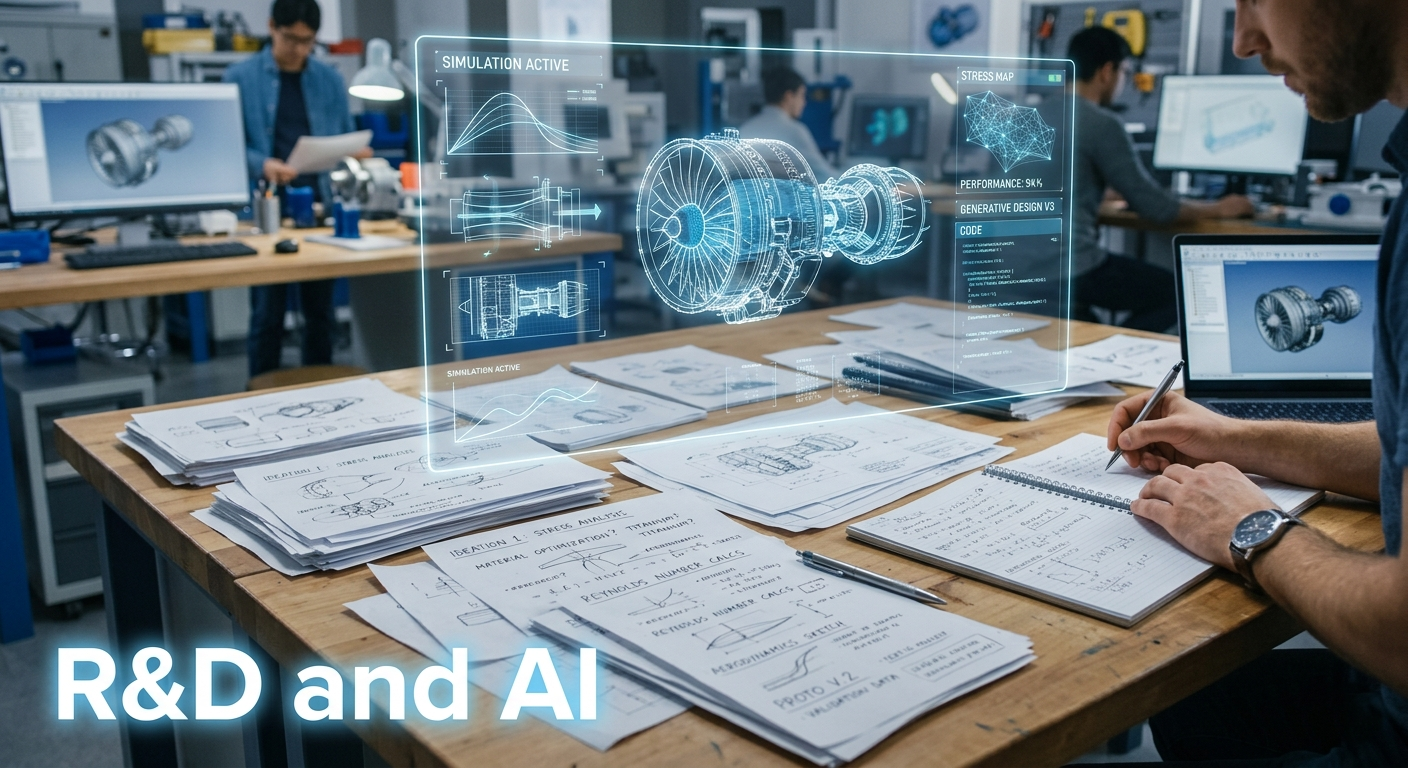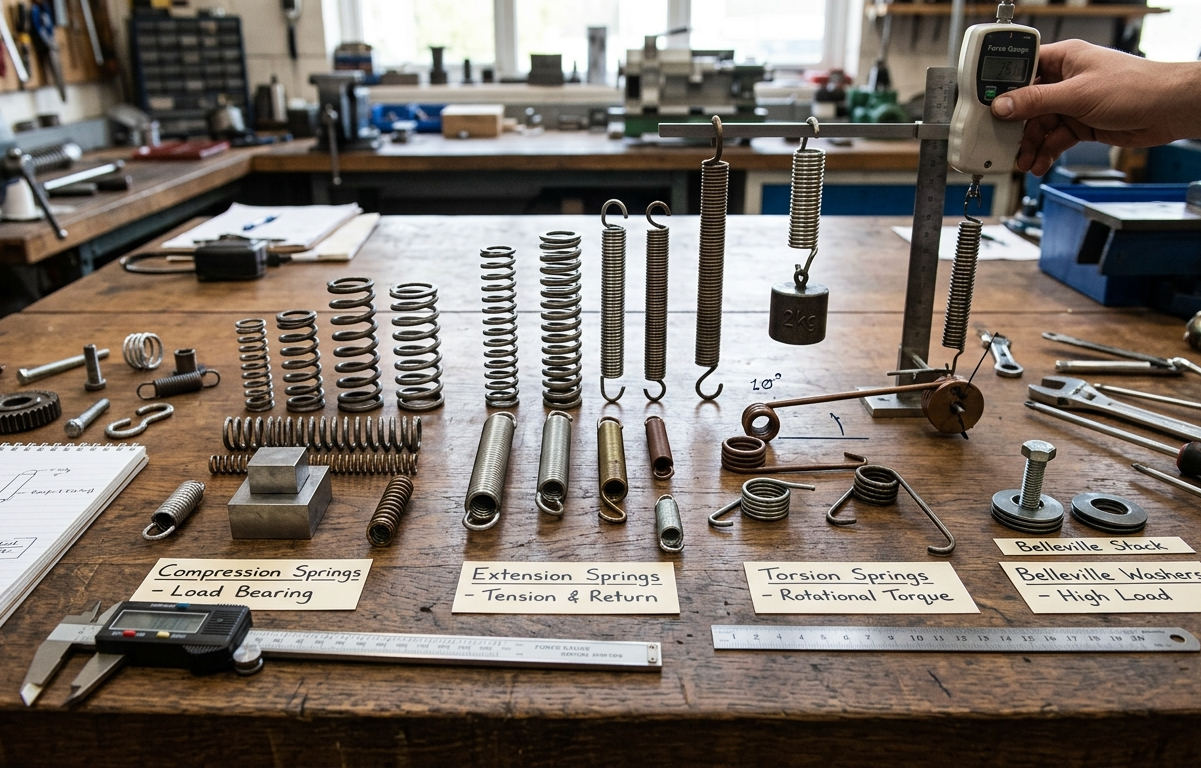
Springs are fundamental mechanical components designed to store and release energy through elastic deformation, acting as the silent backbone of modern machinery. From the microscopic springs in digital sensors to the massive suspension systems of heavy-duty locomotives, these devices are essential for controlling motion, absorbing shock, and maintaining force in virtually every industrial application. In this exhaustive guide, we will explore the history, types, materials, mathematics, and future of these ubiquitous mechanical wonders.
1. A Brief History of Elasticity and Innovation
Before diving into the technical specifications, it is essential to understand that the spring is one of humanity’s oldest mechanical concepts. The bow and arrow, used by ancient civilizations for hunting and warfare, is essentially a large leaf spring designed to store potential energy in the limbs of the bow and release it as kinetic energy to propel a projectile.
During the Renaissance, the development of the mainspring revolutionized timekeeping. Before the 15th century, clocks relied on heavy weights and gravity, meaning they had to remain stationary. The invention of the coiled metal spring allowed for the creation of “portable” clocks, which eventually evolved into the pocket watch.
The scientific understanding of springs took a massive leap forward in 1678 when British physicist Robert Hooke published his law of elasticity. Hooke’s discovery provided the mathematical framework that allowed engineers to move from trial-and-error to precise mechanical design. Today, we stand on the shoulders of these historical innovations as we push spring technology into the realms of nanotechnology and aerospace.
2. The World of Springs: A Detailed Taxonomy
To understand springs, one must first categorize them by how they handle force. While the “coil” is the most recognizable shape, the geometry of a spring is dictated strictly by its intended function.
2.1 Compression Springs
Compression springs are open-coil helical springs that offer resistance to a compressive force applied axially. They are usually coiled as a constant diameter cylinder, though they can be conical, concave (barrel), or convex (hourglass).
- Function: Their primary job is to resist being squeezed.
- Design Variants: The ends of compression springs can be “open,” “open and ground,” “closed,” or “closed and ground.” Grinding the ends provides a flat surface for the spring to sit flush against its mating part, which is critical for preventing buckling.
- Variable Pitch: For advanced applications, the pitch (the distance between coils) can vary throughout the length. This allows the spring to have a “progressive” rate, where the spring becomes stiffer the more it is compressed.
2.2 Extension Springs
Unlike compression springs, extension springs are designed to operate with a tension force. They are characterized by tightly wound coils that touch one another in the unloaded state.
- Initial Tension: Manufacturers wind these so tightly that a specific amount of force (initial tension) is required before the coils even begin to separate. This is achieved by “back-twisting” the wire during the coiling process.
- End Configurations: They require hooks or loops at both ends to attach to other components. Common styles include German loops, English loops, and side loops. The stress at the hook is often higher than in the body, making the hook the most common point of failure.
2.3 Torsion Springs
Torsion springs work through a twisting motion or torque. They are helical springs that exert a rotary force.
- Mechanics: When you rotate the ends of a torsion spring, the material is actually subjected to bending stress rather than torsional stress, despite the name. As they are wound up, the coil diameter decreases and the body length increases—factors that must be accounted for in the housing design.
- Double Torsion Springs: These consist of one right-hand and one left-hand coil section connected, usually by a straight section of wire, and working in parallel to double the torque.
2.4 Constant Force Springs
These are tightly coiled ribbons of steel that exert a near-constant force throughout their deflection. Unlike helical springs, which follow Hooke’s Law ($F = kx$), constant force springs do not increase in resistance the further they are pulled.
- Mechanics: The spring is a pre-stressed flat strip that forms a coil. When the strip is extended, the inherent stress resists the loading force at a constant rate.
- Application: Used in retractable tape measures, window counterbalances, and brush springs for electric motors.
2.5 Belleville Washers (Disc Springs)
These are washer-shaped components with a conical frustum geometry. They are used where high loads are required in very restricted spaces.
- Stacking Strategies:
- In Series: Stacking them face-to-face increases the total deflection but keeps the load capacity the same as a single washer.
- In Parallel: Stacking them nested together increases the load capacity but the deflection remains the same as a single washer.
- Damping: Parallel stacks also provide friction between the washers, offering a natural damping effect for shock absorption.
2.6 Wave Springs
Wave springs are made from flat wire that has waves added to it. They occupy significantly less space than traditional round-wire compression springs (up to 50% less height for the same force).
- Multi-Turn Wave Springs: These use multiple layers of waves to provide a larger range of travel, often replacing helical springs in tight assemblies like bearing preloads.
2.7 Leaf Springs
One of the oldest types of springs, the leaf spring consists of one or more flat strips (leaves) of spring steel. In multi-leaf versions, the strips are stacked in decreasing lengths. They are primarily used in heavy-duty vehicle suspensions because they can distribute large loads over a wider area of the vehicle’s chassis.
3. Materials Science: What Makes a Spring “Springy”?
The performance of a spring depends entirely on the material’s elastic limit—the point at which it can be deformed and still return to its original shape. This property is defined by the Modulus of Elasticity ($E$) and the Shear Modulus ($G$).
3.1 Carbon Steels
- Music Wire (ASTM A228): This is the “gold standard” for small springs. It has high tensile strength and can withstand repeated loading cycles without fatigue. It is cold-drawn and offers the highest dimensional precision.
- Hard Drawn Wire (ASTM A227): A cheaper alternative for non-critical applications like toys or simple household items where high precision and fatigue life are not required.
- Oil-Tempered Wire (ASTM A229): This wire is heat-treated before coiling. It is used primarily for larger springs where cold-drawing becomes impractical.
3.2 Alloy Steels
When carbon steel isn’t enough, engineers turn to alloys to handle extreme environments or higher stresses.
- Chrome Vanadium (ASTM A231/A232): Excellent for high-stress applications and high-temperature environments (up to $220^\circ C$). It is commonly used in aircraft engines and heavy machinery.
- Chrome Silicon (ASTM A401): The preferred choice for high-impact loads and high-speed cycles, such as those found in performance automotive valve springs. It can be heat-treated to higher hardness levels than chrome vanadium.
3.3 Stainless Steels
In environments where corrosion is a threat—such as food processing, medical devices, or marine equipment—stainless steel is mandatory.
- 302/304 Stainless: General-purpose corrosion resistance. It is slightly magnetic after cold working.
- 316 Stainless: Offers better corrosion resistance to chlorides (like seawater) but has slightly lower strength than 302.
- 17-7 PH: A precipitation-hardened steel that offers much higher strength than standard 300-series stainless, maintaining its properties up to $315^\circ C$.
3.4 Non-Ferrous Alloys and Superalloys
- Phosphor Bronze: Offers good electrical conductivity and corrosion resistance. It is non-magnetic and often used in electrical switches and marine instruments.
- Beryllium Copper: Offers the best combination of strength, conductivity, and corrosion resistance of any copper alloy. It is used in critical aerospace components but is very expensive.
- Inconel (X-750): A nickel-chromium alloy used for extreme high-temperature applications (up to $700^\circ C$) such as gas turbines and exhaust systems.
- Elgiloy: A cobalt-chromium-nickel alloy originally developed for watch springs. It is extremely resistant to corrosion and fatigue, making it ideal for medical implants and oil-well equipment.
4. The Physics and Calculation of Springs
Designing a spring is a balancing act between geometry, material properties, and space constraints. All calculations below follow the standard mathematical notation supported by the WordPress Jetpack plugin.
4.1 Hooke’s Law
The fundamental equation for spring behavior is:
$$F = k \cdot x$$
Where:
- $F$ is the force applied (Newtons).
- $k$ is the spring constant or “rate” ($N/mm$).
- $x$ is the displacement or deflection from the equilibrium position ($mm$).
4.2 Calculating the Spring Rate ($k$)
For a standard helical compression or extension spring, the rate is determined by the physical dimensions and the material’s rigidity:
$$k = \frac{G \cdot d^4}{8 \cdot D^3 \cdot n}$$
Where:
- $G$ is the Shear Modulus of the material (typically $\approx 79,300 \, MPa$ for steel).
- $d$ is the wire diameter.
- $D$ is the mean coil diameter (Outer Diameter minus wire diameter).
- $n$ is the number of active coils.
Key Insight: Because $d$ is raised to the 4th power, even a tiny increase in wire thickness significantly increases the stiffness of the spring. Conversely, because $D$ is cubed in the denominator, increasing the diameter of the coil makes the spring much softer.
4.3 Stress Considerations and the Wahl Factor
The stress in a helical spring is primarily torsional. However, the inner surface of the coil experiences higher stress due to the curvature of the wire. Engineers use the “Wahl Factor” ($K$) to correct for this:
$$K = \frac{4C – 1}{4C – 4} + \frac{0.615}{C}$$
Where $C$ is the spring index ($D/d$). The total corrected stress ($\tau$) is calculated as:
$$\tau = K \cdot \frac{8 \cdot F \cdot D}{\pi \cdot d^3}$$
If $\tau$ exceeds the material’s elastic limit, the spring will “set” (permanently deform) or break.
4.4 Buckling and Stability
Long compression springs have a tendency to buckle like a slender column. As a rule of thumb, if the free length of the spring is more than four times the mean diameter, it should be supported by a rod or placed within a tube to maintain alignment. The critical buckling load ($F_{crit}$) can be modeled using the following proportionality:
$$F_{crit} \propto \frac{E \cdot I}{L^2}$$
Where $E$ is the Young’s Modulus, $I$ is the moment of inertia, and $L$ is the length.
5. Advanced Manufacturing and Treatments
The lifecycle of a spring involves more than just coiling wire. The finishing processes determine the spring’s reliability and lifespan.
5.1 Cold vs. Hot Winding
- Cold Winding: Used for wire diameters up to roughly 16mm. The wire is coiled at room temperature, which induces beneficial internal stresses that increase strength.
- Hot Winding: For very large springs (like those on freight trains), the steel is heated to a red-hot state (around $900^\circ C$) to make it pliable enough to coil. These springs must be quenched and tempered afterward.
5.2 Stress Relieving
After coiling, springs contain “residual stresses” from the bending process. If not removed, these stresses can cause the spring to warp or fail. Springs are heated to a moderate temperature (around $250^\circ C$ to $450^\circ C$) for a set time to “relax” the molecular structure without losing the hardness.
5.3 Shot Peening
This is a cold-working process where the spring is blasted with small steel or ceramic beads (shot). This creates a compressive residual stress layer on the surface of the wire, which significantly increases resistance to fatigue cracks. Shot peening can double or triple the fatigue life of a high-stress spring.
5.4 Surface Finishes and Coatings
To protect against the elements and aesthetic requirements, several finishes are applied:
- Zinc Plating: Offers basic sacrificial corrosion protection.
- Black Oxide: A conversion coating used primarily for aesthetics and mild corrosion resistance in oily environments.
- Powder Coating: A thick, durable plastic-like finish that provides excellent protection against harsh chemicals and physical abrasion.
- Passivation: Used for stainless steel to remove surface iron and enhance the protective oxide layer.
6. Industrial Applications: Springs in Action
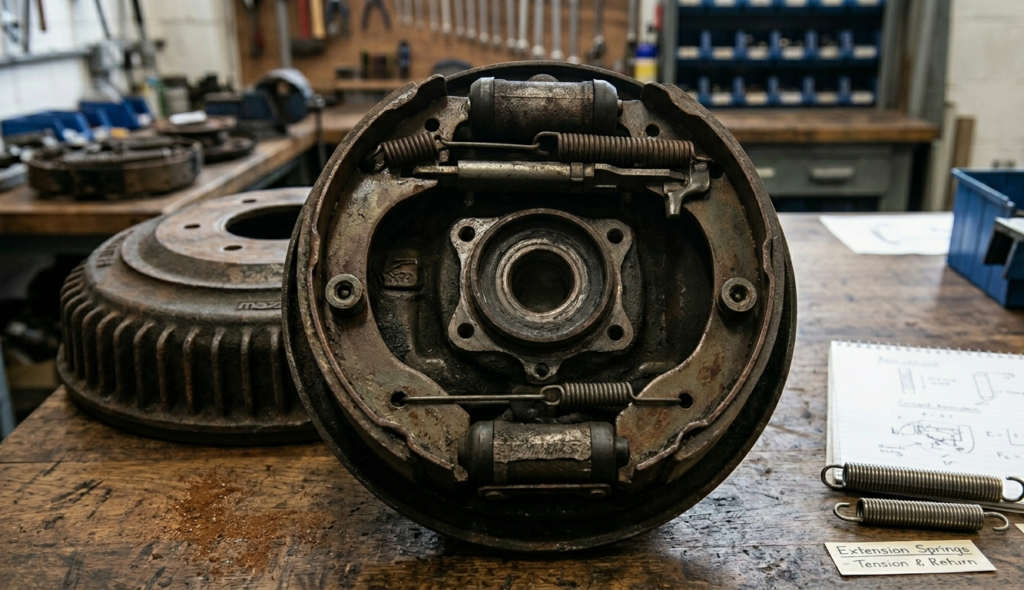
Springs are found in virtually every sector of human industry. Here are detailed examples:
6.1 Automotive Suspension and Engine Valvetrain
- Chassis Springs: Coil springs or leaf springs support the vehicle’s weight. Modern “active” suspensions use springs in conjunction with hydraulic actuators to adjust ride height in real-time.
- Valve Springs: These are among the highest-stressed components in an engine. In a car racing at 8,000 RPM, the valve spring must open and close 4,000 times per minute. Failure here leads to “valve float,” which can destroy an engine.
6.2 Aerospace Fasteners and Safety Systems
- Landing Gear: Massive compression springs (often assisted by nitrogen gas) absorb the immense kinetic energy of an aircraft touching down.
- Ejection Seats: Powerful springs are used in the sequencing mechanisms of pilot ejection systems to ensure components move in the exact order required during a high-speed emergency.
6.3 Medical Devices and Biotechnology
- Surgical Staplers: Precision springs ensure that staples are deployed with the exact force needed to close a wound without crushing the tissue.
- Drug Delivery Pens: Insulin pens use compression springs to provide a consistent force, ensuring the exact dosage of medicine is delivered every time.
6.4 Consumer Electronics and Robotics
- Haptic Feedback: Small springs in controllers and touchpads provide the tactile “resistance” that makes digital interactions feel physical.
- Robotic Joints: “Series Elastic Actuators” use springs between the motor and the joint. This allows robots to interact safely with humans by providing a “buffer” that can absorb unexpected impacts.
6.5 Energy Sector and Infrastructure
- Wind Turbines: Springs are used in the braking systems of wind turbine blades. When wind speeds become dangerously high, spring-loaded brakes engage to prevent the turbine from spinning out of control.
- Seismic Isolation: Large buildings in earthquake-prone areas are sometimes built on “spring-damper” foundations that isolate the structure from the shaking ground.
7. Failure Modes: Why Do Springs Fail?
Even the best-designed spring has a finite life. Understanding failure is key to preventative maintenance.
- Fatigue: The most common cause. Repeated loading and unloading creates microscopic cracks that grow until the remaining material can no longer support the load.
- Corrosion Pitting: Small spots of rust act as “stress concentrators,” giving fatigue cracks a place to start.
- Hydrogen Embrittlement: Occurs during plating or acid cleaning. Hydrogen atoms enter the steel, making it brittle and prone to sudden, “glass-like” shattering under load.
- Creep and Relaxation: At high temperatures, a spring under constant load will slowly lose its force over time, a phenomenon known as relaxation.
8. The Future: Smart Springs and Nanomaterials
As we move into the era of Industry 4.0, spring technology is evolving beyond simple mechanical coils.
8.1 Shape Memory Alloys (SMAs)
Materials like Nitinol (Nickel-Titanium) can “remember” their original shape. When heated, a Nitinol spring that has been deformed will return to its programmed shape with significant force. This is used in “solid-state” actuators that require no motors or gears.
8.2 Carbon Nanotube Springs
At the molecular level, researchers are developing springs made from carbon nanotubes. These possess energy densities orders of magnitude higher than steel, potentially leading to ultra-lightweight energy storage systems for satellites and micro-robotics.
8.3 Additive Manufacturing (3D Printing)
3D printing allows for the creation of “lattice” springs—non-traditional geometries that can provide multi-directional damping or varying stiffness in a single, monolithic part. This eliminates the need for complex assemblies in aerospace applications.
9. Summary
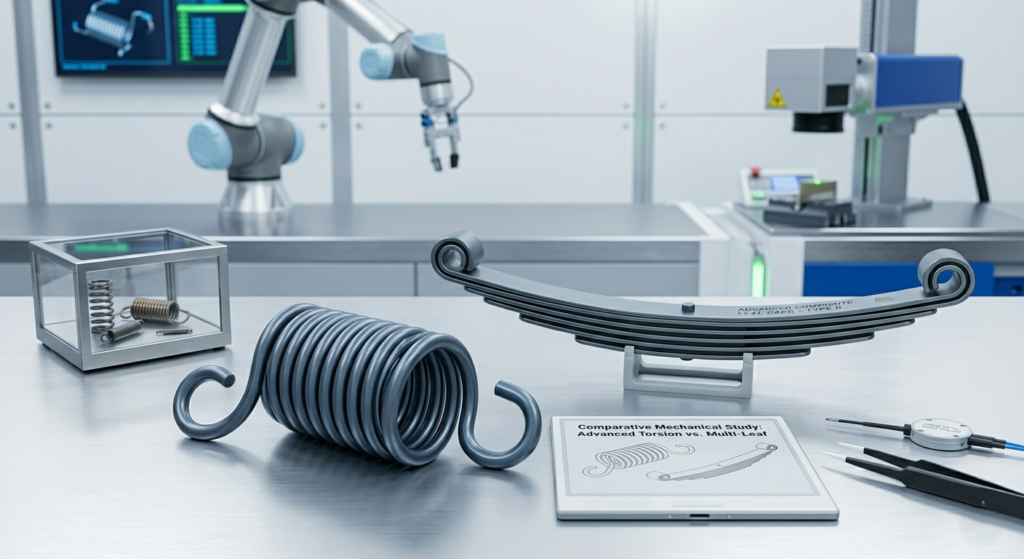
Springs are far more than simple coils of wire; they are sophisticated energy-storage devices that require a deep understanding of materials science, classical physics, and precision manufacturing. By selecting the right material—from standard music wire for a pen to exotic Inconel for a jet engine—and applying rigorous mathematical models like Hooke’s Law and the Wahl Factor, engineers can design systems that are both reliable and efficient.
Whether they are protecting our cars from rough roads, ensuring the safety of a transcontinental pipeline, or facilitating life-saving medical procedures, springs remain one of the most vital and enduring inventions in the history of mechanical engineering. Understanding the intricate relationship between wire geometry, material properties, and environmental stresses is the first step in mastering the art and science of spring design.